Google Ranking Factors 2026: What Really Matters, With Evidence
Google ranking factors are the signals Google uses to decide which pages show first for a search. Google uses hundreds of signals, but only a small group has real evidence behind it. In 2026 the factors that matter most are helpful, original content that matches what the searcher wants, clear relevance signals in your title and headings, links from trusted websites, user satisfaction signals from clicks, site wide quality, freshness where it matters, a fast and stable page experience, and a site Google can crawl and index without problems.
Most ranking factor lists online were written years ago and mix proven facts with guesses. This guide is different. Every factor below is graded by the strength of its evidence: confirmed by Google, proven in court or in Google’s leaked documents, supported by strong industry data, or a myth. It also covers the 2026 core updates and how AI Overviews now choose which pages to cite.
Key takeaways
- Google confirms its main ranking systems in its own guide. Content quality, relevance, links, freshness and spam detection are all on that list.
- Court testimony in the United States v. Google case confirmed that Google uses click data through a system called NavBoost.
- Word count, keyword density, meta keywords and domain age are not ranking factors.
- Only 37.9% of pages cited in AI Overviews also rank in the top 10, down from about 76% in mid 2025. Covering a topic fully now matters as much as ranking for one keyword.
- For local businesses, Google ranks map results on relevance, distance and prominence.
In this guide: How to read the evidence · How Google ranks a page · The factors that matter · Factor table · Myths · AI Overviews · 2026 updates · Australian businesses · 30 day plan · FAQ
Why most ranking factor lists are out of date
The famous lists of 200 Google ranking factors were first written more than ten years ago. Many items on them come from old patents, small tests or guesses, and some describe systems Google has since retired, such as Panda, Penguin and Hummingbird. A long list also treats every factor as equal, when in practice a handful of factors decide most rankings.
Since then, three things changed what we actually know:
- Google published its own guide to its ranking systems in November 2022 and keeps it updated. The latest version lists 17 current systems and marks Panda, Penguin, Hummingbird and the helpful content system as retired or merged into core ranking.
- Google’s internal documentation leaked. In May 2024 SEO researchers published analysis of Google’s Content Warehouse API documents: more than 2,500 pages describing 14,014 attributes across 2,596 modules. The documents show which data Google stores, not how much each item counts.
- Google executives gave sworn testimony in the United States v. Google antitrust case, including details of how click data is used in ranking.
So in this guide every factor gets one of four evidence levels:
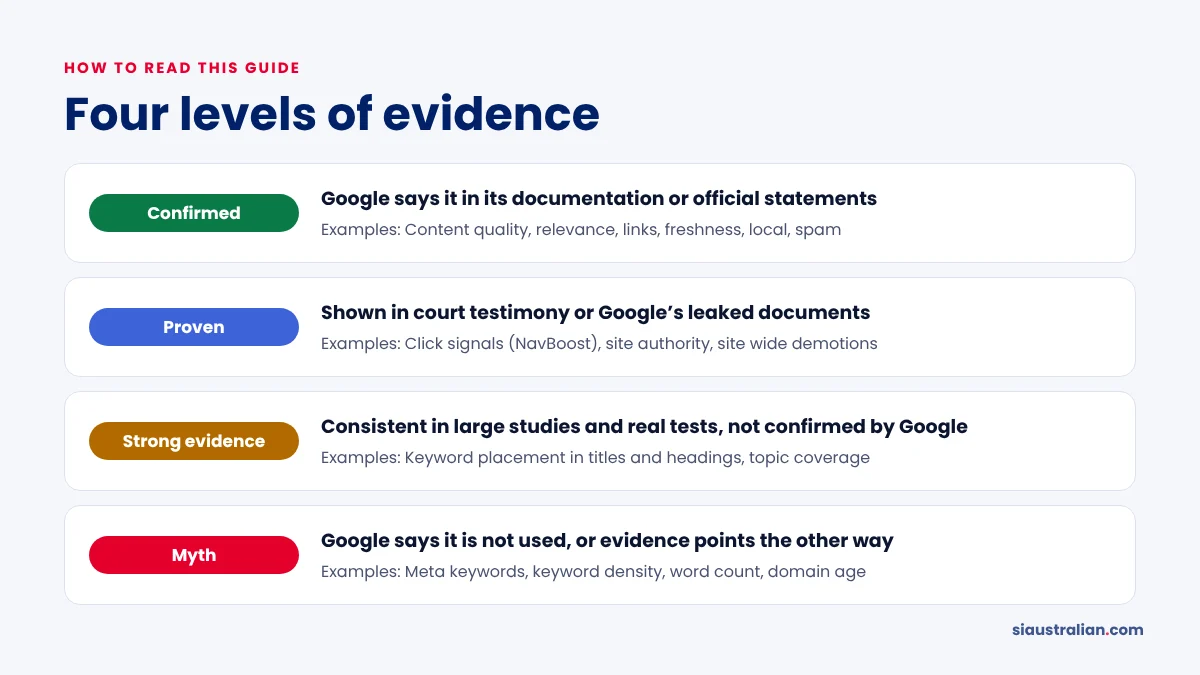
- Confirmed: Google says it in its documentation or official statements.
- Proven: shown by court testimony or the leaked documents.
- Strong evidence: consistent results in large industry studies and real world testing, but not confirmed by Google.
- Myth: Google has said it is not used, or the evidence points the other way.
How Google ranks a page, in four steps
Ranking factors only work on pages Google has found and stored. It helps to see the whole process before looking at single factors.
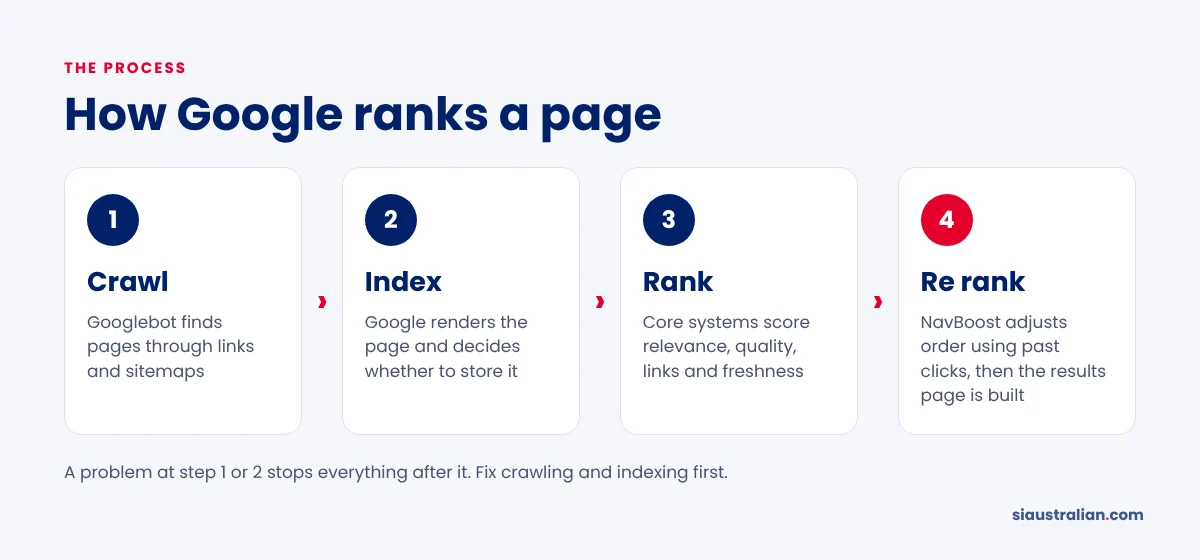
- Crawl. Googlebot finds your page through links and your XML sitemap, then downloads it.
- Index. Google renders the page, works out what it is about, and decides whether to store it. Duplicate and low value pages are often left out.
- Rank. Core ranking systems score the indexed pages for the search: relevance, quality, links, freshness and more.
- Re rank and present. Systems such as NavBoost adjust the order using what past searchers clicked on and stayed on. Google then builds the results page, including AI Overviews, map results and other features.
A problem at step one or two stops everything after it. That is why technical SEO comes first on any new site.
The Google ranking factors that matter most in 2026
1. Helpful, original content made for people
Evidence: Confirmed. Google’s helpful content system was built to reward content made for people rather than for search engines. In March 2024 Google made it part of its core ranking systems, so it now runs all the time instead of in separate updates. Google also confirms an original content system, which helps original reporting rank above pages that only repeat it, and a reviews system that rewards reviews with first hand testing and real insight.
What this means in practice:
- Answer the question fully, so the reader does not need to go back to Google.
- Add something the other results do not have: your own photos, data, prices, examples or experience.
- Write for one clear audience. A page for Australian homeowners reads differently from a page for American renters.
- Avoid pages that exist only to catch a keyword, such as thin suburb pages with the town name swapped.
2. Matching search intent and relevance
Evidence: Confirmed. Google lists several AI systems that work out what a search means and which pages match it: RankBrain, neural matching, BERT and passage ranking. These systems mean a page can rank for searches that use different words, as long as it covers the same idea. Passage ranking means one strong section in a long page can rank on its own.
Intent matters as much as topic. Search plumber Parramatta and Google shows local businesses. Search how to fix a leaking tap and it shows guides and videos. A sales page will struggle to rank for a how to search, however good it is.
- Search your target phrase and look at what already ranks: guides, product pages, local results or videos.
- Build the type of page Google is already showing, then make it better.
- Cover the related questions people ask, because AI systems now break one search into many smaller ones.
3. Keywords and entities in the places that count
Evidence: Confirmed for basic relevance, strong evidence for placement. Google says the most basic relevance signal is whether a page contains the same words as the search, especially in titles, headings and body text. Modern systems also understand entities: people, places, businesses and things, and how they relate.
- Put the main phrase in the title tag, the H1 and the first paragraph.
- Use related terms naturally in subheadings. For an electrician page that might be switchboard upgrades, safety switches and licence numbers.
- Name entities clearly: your business name, your suburb, your services and the brands you work with.
- Do not repeat the keyword for the sake of it. There is no ideal keyword density.
4. Backlinks and PageRank
Evidence: Confirmed. Google’s ranking systems guide still lists link analysis systems and PageRank. Links from other websites tell Google that your page is trusted and what it is about. The text of the link, and the page it sits on, both add context.
Quality beats quantity. One link from a respected industry site or local news outlet is worth more than hundreds of links from spam directories, and Google’s SpamBrain system is built to find and ignore paid or manipulative links.
- Earn links with useful assets: original data, local guides, tools or strong case studies.
- Get listed in genuine Australian business directories and industry associations.
- Ask suppliers, partners and clients you work with to link where it makes sense.
- Avoid link packages that promise hundreds of links for a low price.
5. User satisfaction and click signals (NavBoost)
Evidence: Proven. For years Google played down the role of clicks. In the United States v. Google trial, Google’s Pandu Nayak testified that a system called NavBoost uses click data from roughly the past 13 months to help rank results. The leaked documents also describe click measures such as good clicks, bad clicks and last longest clicks.
In plain terms, if searchers click your result and stay, that helps you keep or improve your position. If they click and quickly return to Google to choose another result, that hurts.
- Write titles and descriptions that match the search and earn the click honestly.
- Give the answer early on the page, then the detail.
- Remove anything that makes people leave: slow loading, pop ups on mobile, walls of text.
- Do not try to fake clicks. Google filters unnatural click patterns.
6. Site wide quality and authority
Evidence: Proven in the leaked documents, partly confirmed. Google has long said it does not use third party scores like Domain Authority or Domain Rating. Those are tool metrics, not Google signals. But the leaked documents include a site level attribute called siteAuthority, as well as site wide demotions for low quality content and poor navigation.
This matches what SEOs see after core updates: whole sites move up or down together. A large number of weak pages can hold back your strong ones.
- Improve or remove thin, outdated and duplicate pages.
- Keep a clear structure, so every important page is a few clicks from the homepage.
- Build your brand. People searching for your business by name is a healthy sign.
7. Experience, expertise, authority and trust
Evidence: Confirmed as a goal, not a single factor. Experience, Expertise, Authoritativeness and Trust (often shortened to EEAT) come from Google’s Search Quality Rater Guidelines. Raters do not change rankings directly, but their feedback is used to test whether Google’s systems reward the right pages. Trust is the most important part, and it matters most for health, money, legal and safety topics.
- Show who wrote the content and why they know the subject.
- Show real business details: ABN, licence numbers, contact details and service areas.
- Back up claims with sources, and show your own results where you can.
8. Freshness, where the search needs it
Evidence: Confirmed. Google’s freshness systems show newer content for searches where fresh results are expected, such as news, prices, laws and yearly guides. For a timeless topic, a recent date gives no advantage on its own.
- Update pages when facts change, and say what changed.
- Keep yearly content, such as prices or tax guides, current each year.
- Do not change the date without changing the content. That is not an update.
9. Page experience and Core Web Vitals
Evidence: Confirmed, but usually a tie breaker. Google says its core ranking systems reward pages that give a good page experience. Core Web Vitals measure loading speed (Largest Contentful Paint), how quickly a page responds (Interaction to Next Paint, which replaced First Input Delay in March 2024) and visual stability (Cumulative Layout Shift). HTTPS, mobile friendly design and no intrusive pop ups are part of the same picture.
Google has been clear that great content with an average page experience can still outrank a fast page with weak content. Speed will not save a poor page, but a slow page loses clicks and customers.
- Check your pages in PageSpeed Insights and the Core Web Vitals report in Search Console.
- Compress images and remove plugins and scripts you do not need.
- Do not cover content with pop ups on mobile.
10. Crawlability and indexing
Evidence: Confirmed as a requirement. A page Google cannot crawl or index cannot rank. This sounds basic, but it is one of the most common problems we find in audits.
- Check the Pages report in Search Console for pages that are not indexed, and why.
- Make sure every important page has internal links pointing to it. Pages with no internal links are hard for Google to find.
- Keep your XML sitemap clean: only live, indexable pages.
- Stop crawl waste from filter, search and tracking URLs.
11. Structured data
Evidence: Not a direct ranking factor. Google has said schema markup does not directly improve rankings. It helps Google understand your page and makes you eligible for rich results, such as review stars, product prices and breadcrumbs, which can lift clicks. It also gives AI systems clear facts about your business.
- Add Organization or LocalBusiness schema with your real business details.
- Use Product, Article, Breadcrumb and FAQ schema where they fit the page.
- Only mark up content that is visible on the page.
12. Local ranking factors
Evidence: Confirmed. Google’s own help pages say local results are based mainly on three things: relevance, distance and prominence.
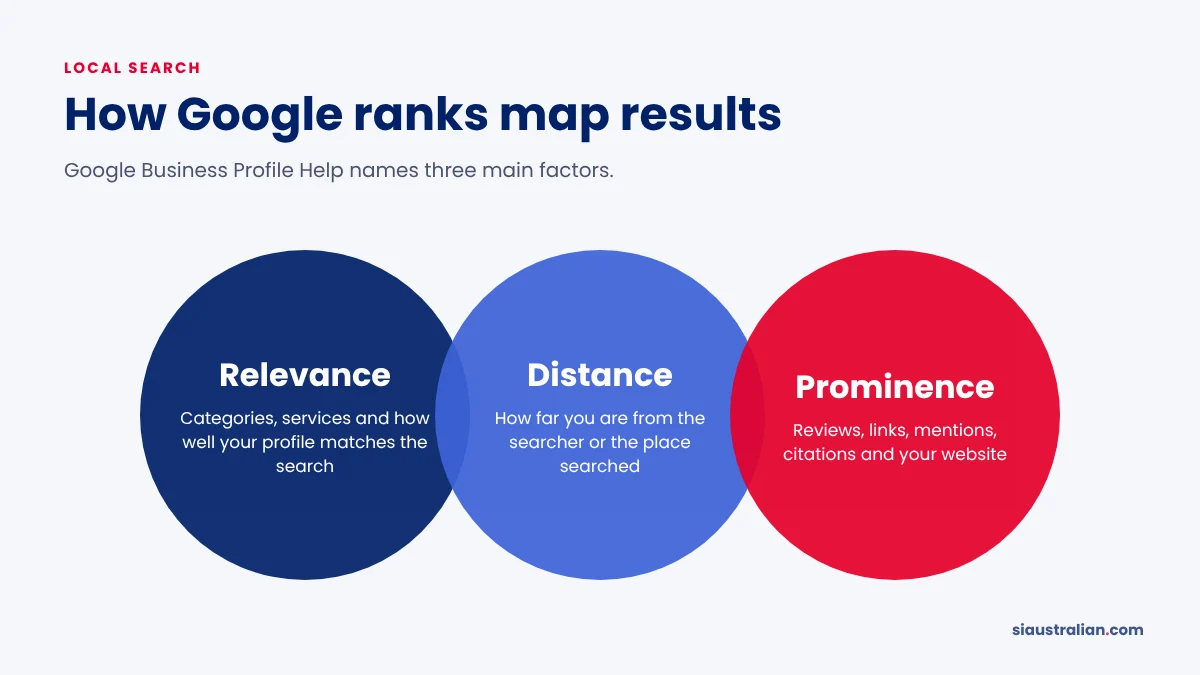
- Relevance: how well your Google Business Profile matches the search. Choose the right primary category and list every service.
- Distance: how far your business is from the searcher or the place named in the search. You cannot change this, but you can set accurate service areas.
- Prominence: how well known your business is. Reviews, links, mentions, directory listings and your website all count.
13. Spam and demotion systems
Evidence: Confirmed. Some factors work against you. Google’s SpamBrain detects spam and link schemes. In March 2024 Google added spam policies on scaled content abuse (mass produced pages made to rank, whether written by people or AI), expired domain abuse and site reputation abuse. Google also confirms removal based demotions for sites with many copyright or personal information removals, an exact match domain system that limits the credit for keyword domains, and a site diversity system that usually shows no more than two results from the same site.
- Do not publish hundreds of near identical pages to target every suburb or keyword.
- Do not buy expired domains to redirect their links.
- Do not rent out sections of your site for unrelated content.
Google ranking factors at a glance
| Factor | Evidence | Impact | First thing to do |
|---|---|---|---|
| Helpful, original content | Confirmed | Very high | Add first hand detail the other results lack |
| Search intent and relevance | Confirmed | Very high | Build the page type Google already ranks |
| Keywords and entities in key places | Confirmed | High | Main phrase in title, H1 and first paragraph |
| Backlinks and PageRank | Confirmed | Very high | Earn links from real, relevant sites |
| Click and satisfaction signals | Proven | High | Better titles and faster answers |
| Site wide quality and authority | Proven | High | Improve or remove weak pages |
| Experience, expertise and trust | Confirmed as a goal | High for money and health topics | Show authors and business details |
| Freshness | Confirmed | Depends on the search | Update pages when facts change |
| Page experience and Core Web Vitals | Confirmed | Medium, often a tie breaker | Fix slow templates and mobile pop ups |
| Crawlability and indexing | Confirmed | Required | Check the Pages report in Search Console |
| Structured data | Indirect | Low for rankings, good for clicks | Add Organization or LocalBusiness schema |
| Local relevance, distance and prominence | Confirmed | Very high for local searches | Complete your Google Business Profile |
| Spam and demotions | Confirmed | Can remove a site from results | Avoid scaled pages and paid link schemes |
Ranking factor myths you can ignore
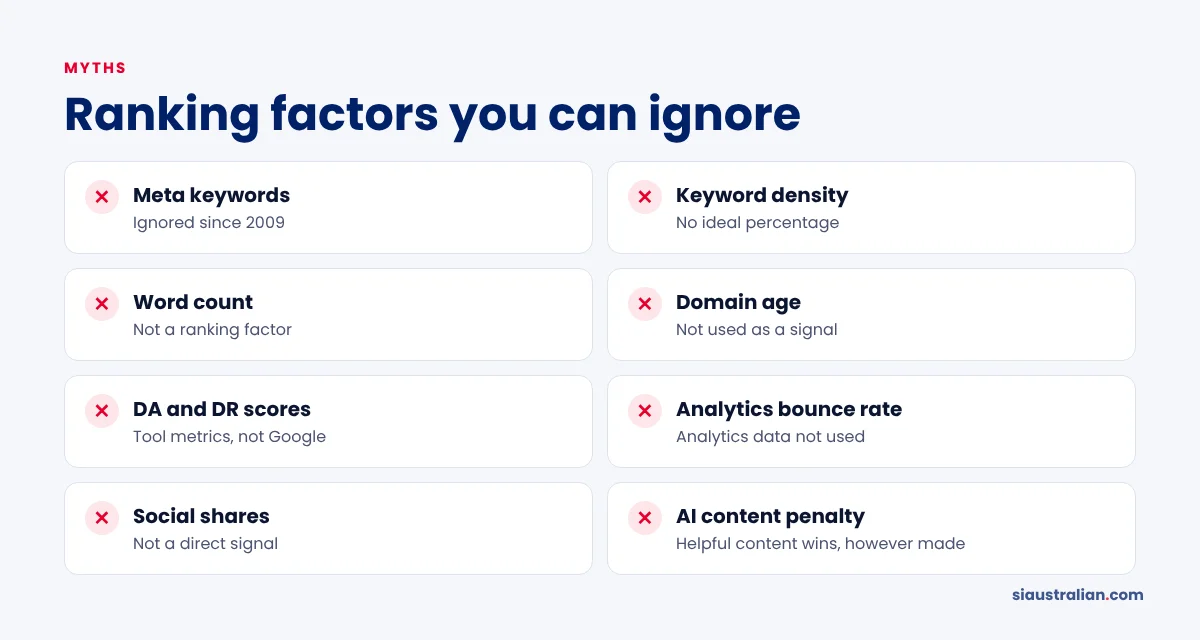
- Meta keywords tag. Google said in 2009 that it does not use it for ranking.
- Keyword density. There is no ideal percentage. Write naturally and cover the topic.
- Word count. Google has said word count is not a ranking factor. Long pages often rank because they cover more, not because they are long.
- Domain age. Google has said it does not use domain age as a ranking signal. Old sites rank well because of what they built over time.
- Domain Authority and Domain Rating. These are scores made by SEO tools. They are useful for comparing sites, but Google does not use them.
- Google Analytics data and bounce rate. Google has said it does not use Analytics data for ranking. Click signals come from search itself.
- Social media likes and shares. Google has said these are not direct ranking signals, though social activity can lead to links and brand searches.
- AI written content is penalised. Google says it rewards helpful content however it is produced. Mass produced pages made to manipulate rankings break its spam policies, whoever writes them.
How AI Overviews and AI Mode change ranking
AI Overviews now sit above the normal results for many searches, and they cite a handful of sources. Ranking well still helps, but it is no longer enough on its own. Ahrefs studied 863,000 searches and about 4 million AI Overview citations in early 2026. Only 37.9% of the cited pages also ranked in the top 10. In their July 2025 study the figure was about 76%.
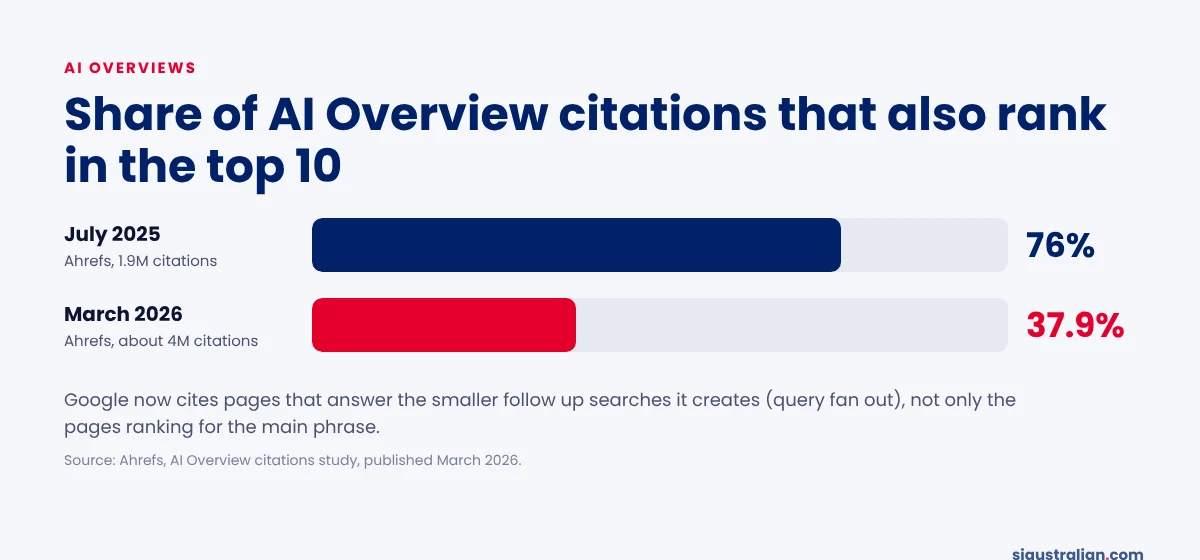
The reason is query fan out. Google’s AI breaks one search into many smaller searches, then cites the best page for each part. A page that answers the follow up questions well can be cited even when it does not rank for the main phrase.
- Start each section with a direct answer in one or two sentences.
- Cover the follow up questions people ask, each under its own heading.
- Keep facts about your business the same everywhere: website, Google Business Profile and directories.
- Consider short videos. YouTube is one of the most cited sources in AI Overviews.
Google updates that shaped ranking factors, 2024 to 2026
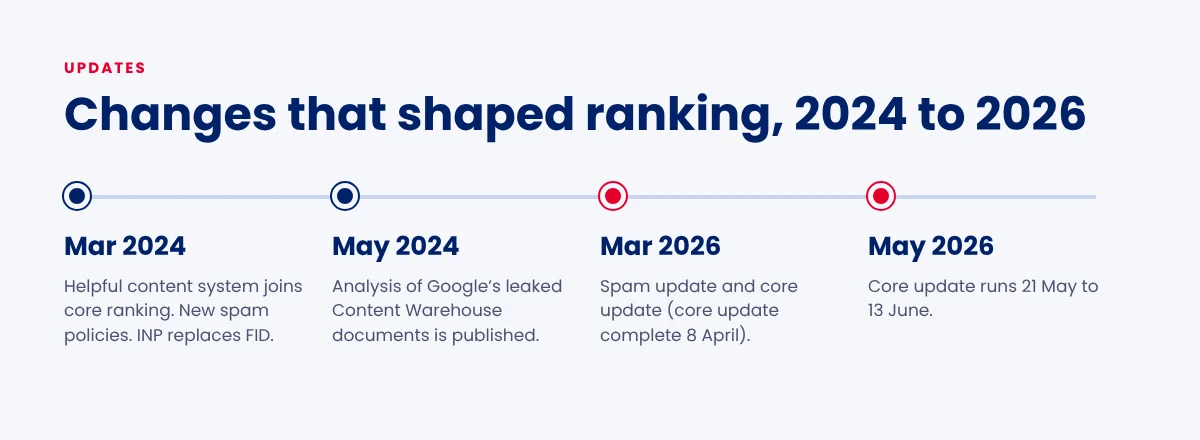
- March 2024: the helpful content system became part of core ranking, and new spam policies on scaled content, expired domains and site reputation abuse began. Interaction to Next Paint replaced First Input Delay in Core Web Vitals.
- May 2024: analysis of Google’s leaked Content Warehouse documents was published, showing attributes for clicks, site authority and site wide demotions.
- March 2026: a spam update and a core update, which completed on 8 April 2026.
- May 2026: a core update that ran from 21 May to 13 June 2026. Google described it as an update to better surface relevant, satisfying content from all types of sites.
Core updates do not target single factors. They change how Google’s systems judge quality overall. If your traffic drops after one, Google’s advice is to review the content of the pages that lost visibility rather than making quick technical changes.
What Google ranking factors mean for Australian businesses
The factors are the same worldwide, but how you apply them changes in Australia.
- Country signals. A .com.au domain tells Google your site is for Australian searchers. If you use .com, show Australian addresses, phone numbers and prices in AUD.
- Australian English. Use the words Australians search: tradie, ute, optimisation, aircon, colour. It improves relevance and trust.
- Local search drives most enquiries. For trades, clinics and local services, the Google Business Profile and map results usually bring more calls than the normal results.
- Australian citations. Consistent listings on Australian directories support prominence in local results.
- Trust details. ABN, licence numbers and real Australian reviews matter, both to Google’s quality systems and to customers.
- Lower competition outside capitals. Many regional markets can be won with the basics done well.
A 30 day plan based on the factors that matter
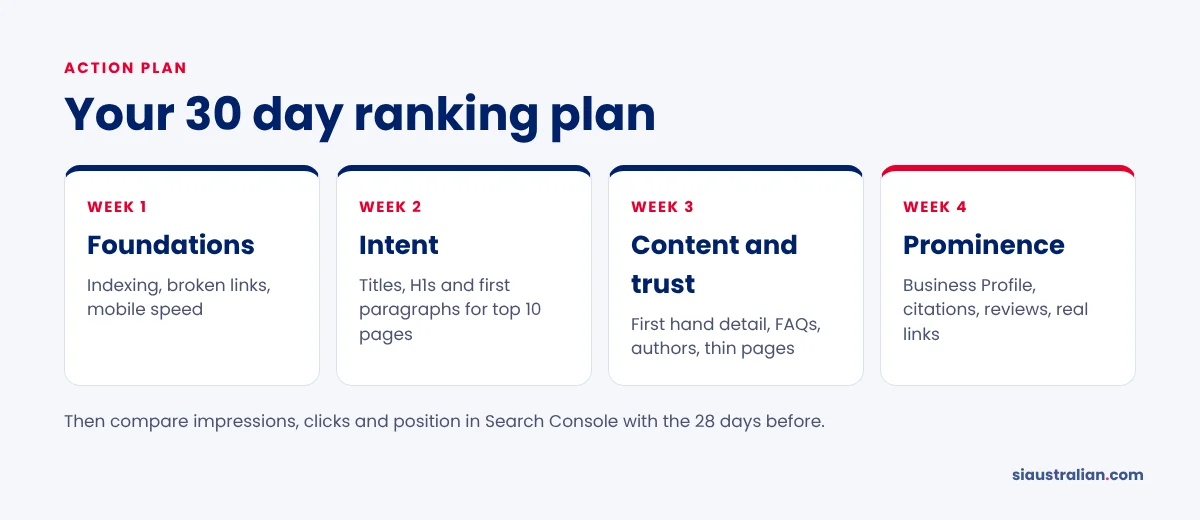
- Week 1, fix the foundations. Check the Pages report in Search Console, fix pages that are not indexed, remove broken links and check mobile speed on your main templates.
- Week 2, match intent and relevance. For your 10 most important pages, check what Google ranks for the main phrase. Rewrite titles, H1s and first paragraphs to match.
- Week 3, improve content and trust. Add first hand detail, photos, prices, FAQs and author or business details. Improve or remove thin pages.
- Week 4, build prominence. Complete your Google Business Profile, fix your directory listings, ask recent customers for reviews and start earning a few real links.
Then measure. Use Search Console to track impressions, clicks and average position for the pages you changed, and compare them with the 28 days before.
Frequently asked questions
How many ranking factors does Google use?
Google has said it uses hundreds of signals, and the leaked documents describe thousands of stored attributes. Google does not publish a full list. What matters is the small group of factors with strong evidence, covered in this guide.
What is the number one Google ranking factor?
There is no single number one factor, and it changes by search. For most searches, helpful content that matches the intent of the search, supported by links from trusted sites, does the most work. For local searches, your Google Business Profile, distance and reviews matter most.
Are backlinks still a ranking factor in 2026?
Yes. Google still lists link analysis and PageRank among its ranking systems. Links from relevant, trusted websites help, while paid and spam links are ignored or can lead to a penalty.
Is page speed a ranking factor?
Yes, as part of page experience and Core Web Vitals, but it usually acts as a tie breaker between pages of similar quality. A faster page also keeps more visitors, which helps your click signals.
Does Google use click data to rank pages?
Yes. Court testimony in the United States v. Google case confirmed that a system called NavBoost uses click data from about the past 13 months to adjust rankings.
How long does it take for ranking changes to show?
Changes to titles and content can show within days to weeks after Google recrawls the page. Link building and site wide quality improvements usually take two to six months.
Sources
- Google Search Central: A guide to Google Search ranking systems
- Google Search Central blog: Introducing the guide to ranking systems
- Hobo: The Google Content Warehouse leak
- Ahrefs: AI Overview citations and the top 10
- Search Engine Land: Google May 2026 core update
- TripleDart: May 2026 core update dates
- Google Business Profile Help: Tips to improve your local ranking
Want to know which ranking factors are holding your site back?
Send us your website. Within one business day a real person checks it against the factors in this guide and emails you the three biggest issues, in plain English. Get your free SEO health check.